
AI Native Services: The biggest opportunity is work that was never outsourced
The standard AI services thesis is straightforward: take a large outsourced workflow, add AI, replace some of the labor, and sell the service back into an existing budget with better margins.
It is a tempting story because everything about it is known. The buyer already exists. The budget already exists. The workflow has a name. And the incumbent vendor has already proven that the customer is willing to let the work leave the building.
That knowledge is also the problem.
Existing outsourced work is already price-discovered
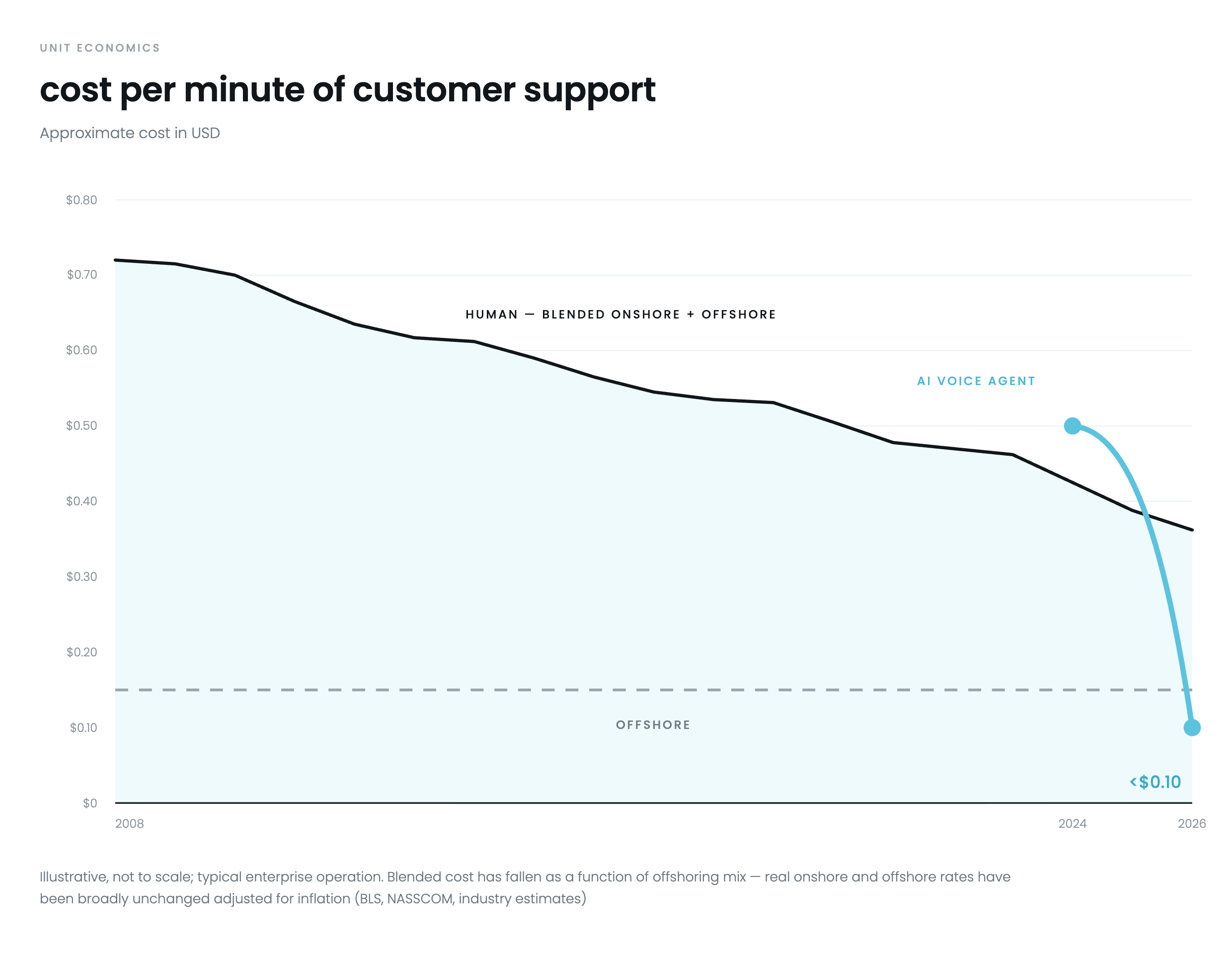
Work that has already been outsourced has usually gone through years of price discovery. The incumbent has the contract, the procurement relationship, the trained labor pool, and an operating model built around two decades of squeezing costs out of the workflow. AI can still create significant value in these markets, but a new entrant has to be much better, faster, cheaper, or more accountable, because "we use AI" is not enough when the alternative is a low-cost offshore services machine that already has the buyer's contract.
The bigger opportunity is work that never left the building
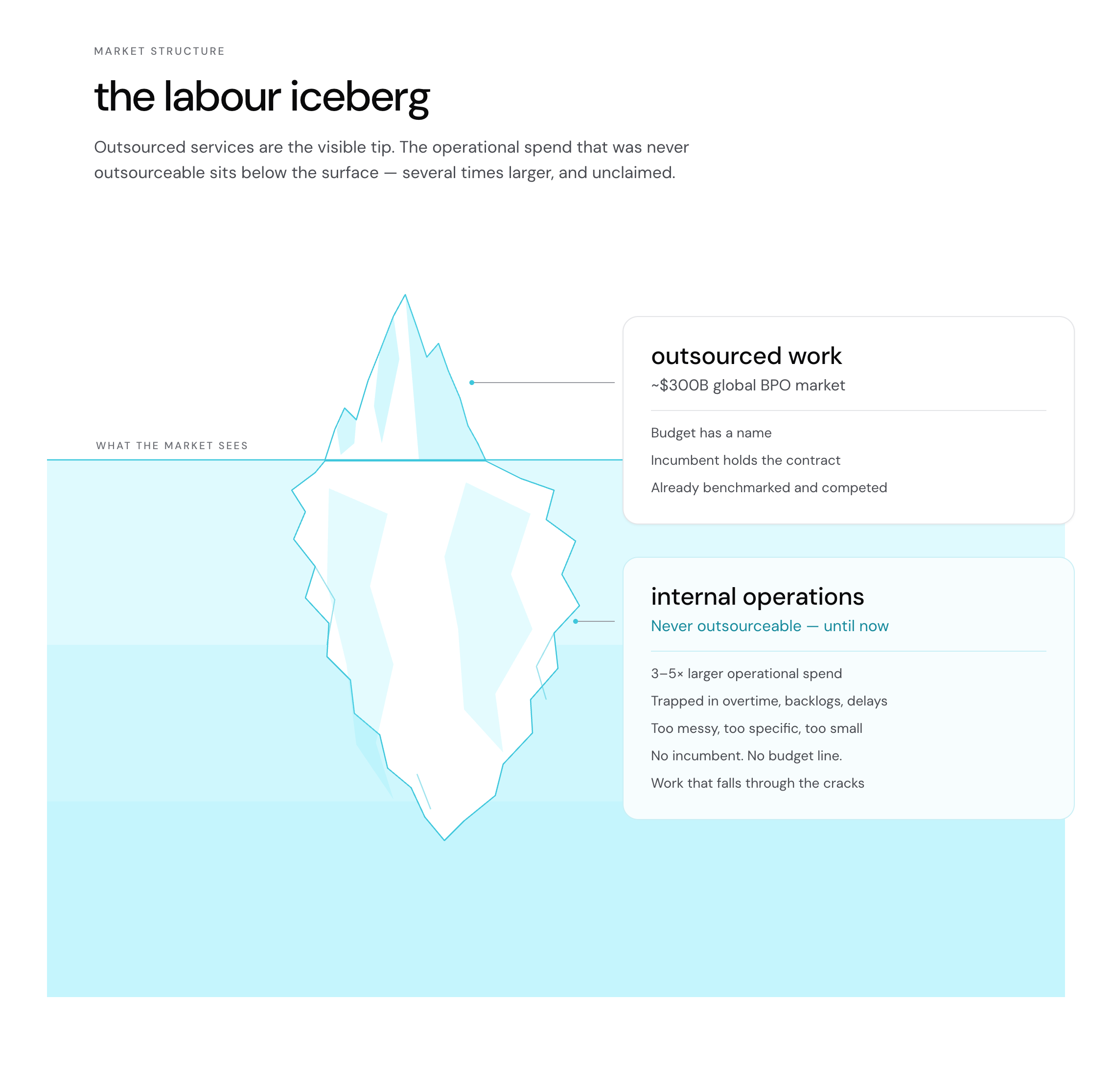
The more interesting opportunity is work that was never outsourced in the first place. This work stayed inside companies because it was too specific for a BPO, too messy for traditional software, too variable to hand off cleanly, or too small for a large services firm to care about. It was paid for through headcount, overtime, delays, rework, missed follow-ups, and managers quietly absorbing coordination work that never showed up as a distinct budget category.
That is the real opportunity for AI native services. Not cheaper BPO, but newly addressable work that companies previously had no choice but to do themselves.
AI makes tacit knowledge serviceable
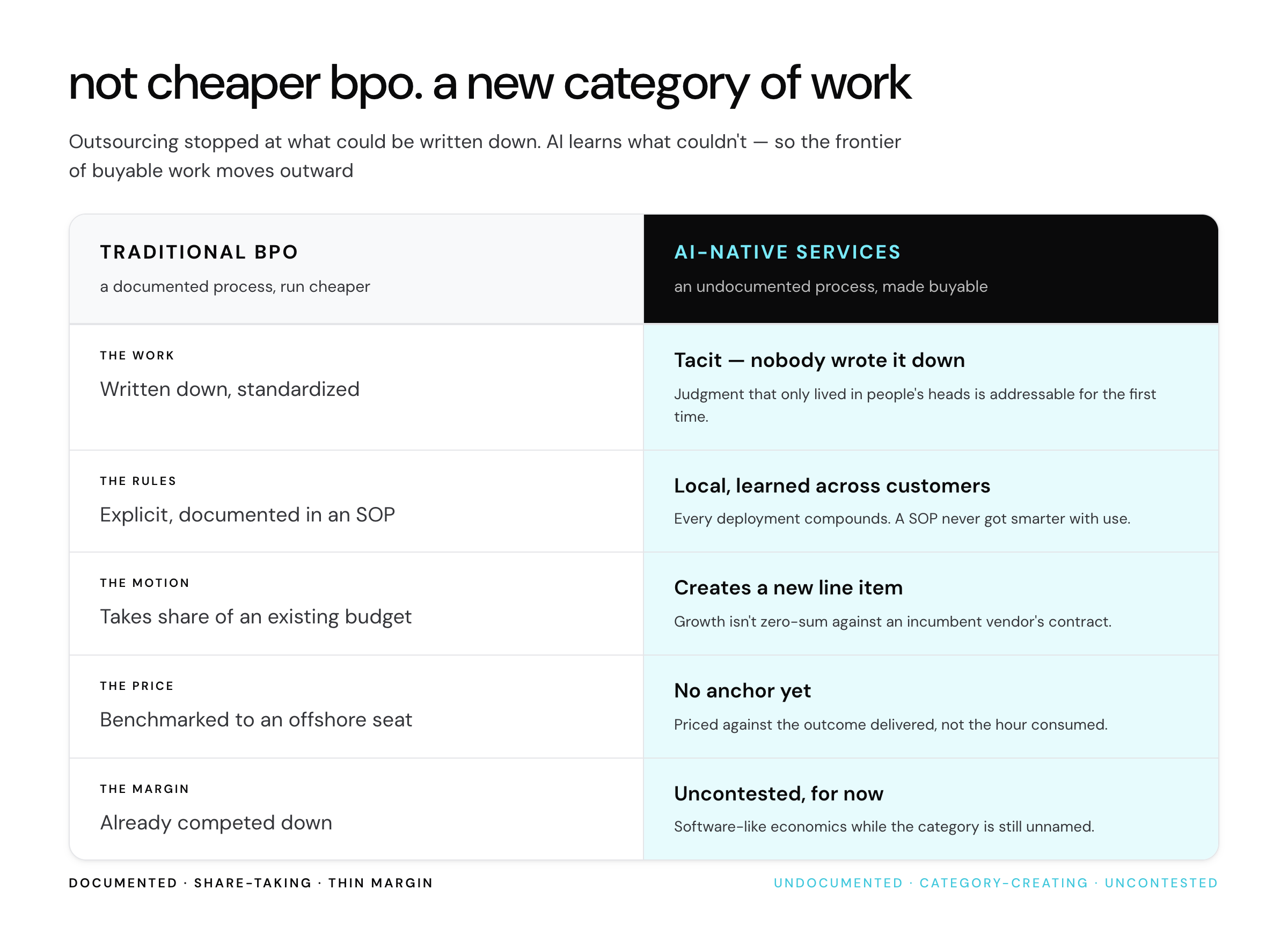
The lazy explanation for AI native services is that AI makes delivery cheaper. That is true, and it is the least interesting thing about them.
Small companies have always had fractional labor problems. A mid-market brokerage might need half an operations associate. A clinic might need extra revenue-cycle capacity for three weeks a quarter. A lender might need a burst of document review when applications spike. Labor markets do not sell clean fractions, so the buyer hires a full person, overloads the team, or lets the backlog grow.
AI-native services can sell the slice of work the customer actually needs: process the submission, chase the missing document, prepare the file, or reconcile the invoice. The interesting part, however, is not that AI can perform these tasks more cheaply. It is that it can absorb the context and judgment required to perform them without the customer having to build the capability internally.
The work stayed internal because it depended on judgment nobody had written down. Which broker always sends incomplete files. Which payer denies a claim unless the appeal is phrased a certain way. Which contract clause looks harmless but creates pain later. Which customer escalation is routine and which one is the first sign of churn.
Old outsourcing stopped at workflows that could be documented. A vendor serving one customer could rarely learn enough local context to be trusted, and traditional software could not automate rules the customer could not fully articulate.
AI changes the learning curve. A service working across many customers, cases, and exceptions can begin to accumulate operating judgment that no single customer sees in full. The knowledge that once made the workflow hard to outsource becomes the asset the service compounds.
There is a fair objection here: much of this knowledge is customer-specific, and if it stays local it is an onboarding cost, not a moat. The way out is to stay narrow. Inside a single workflow and a single ecosystem, the messy details repeat - the exception you learn on the thirtieth customer is usually the one the thirty-first will hit. That is what turns local knowledge into a compounding asset instead of a treadmill.
A simple example: making a 1-2 person function outsourceable
An example of this is Kim.cc, which provides customer support for small teams in e-commerce with fewer than 10 FTEs, often with just 1-2 FTEs - work that was not outsourceable before, due to the context-sharing burden and undocumented workflows involved. By absorbing that tacit context, and focusing only on the Shopify ecosystem to make this scalable, Kim has made that unit of work outsourceable for the first time.
The competitor here is not a large outsourcing firm. It is the employee who knows where every file is, which customer needs hand-holding, which exception matters, and which portal will cause problems this week. The company is not taking share from an incumbent vendor but turning internal labor into a service category.
Where should founders look?
A useful starting point for evaluating an AI native services opportunity is to ask two questions: where does the work live, and where does the labor sit?
Start with where the work lives
For an AI native services company, the first underwriting question should be: where does the work live today?
That answer tells us who the real competitor is, how the buyer experiences the pain, what price anchor they will use, and whether the profit pool has already been competed down.
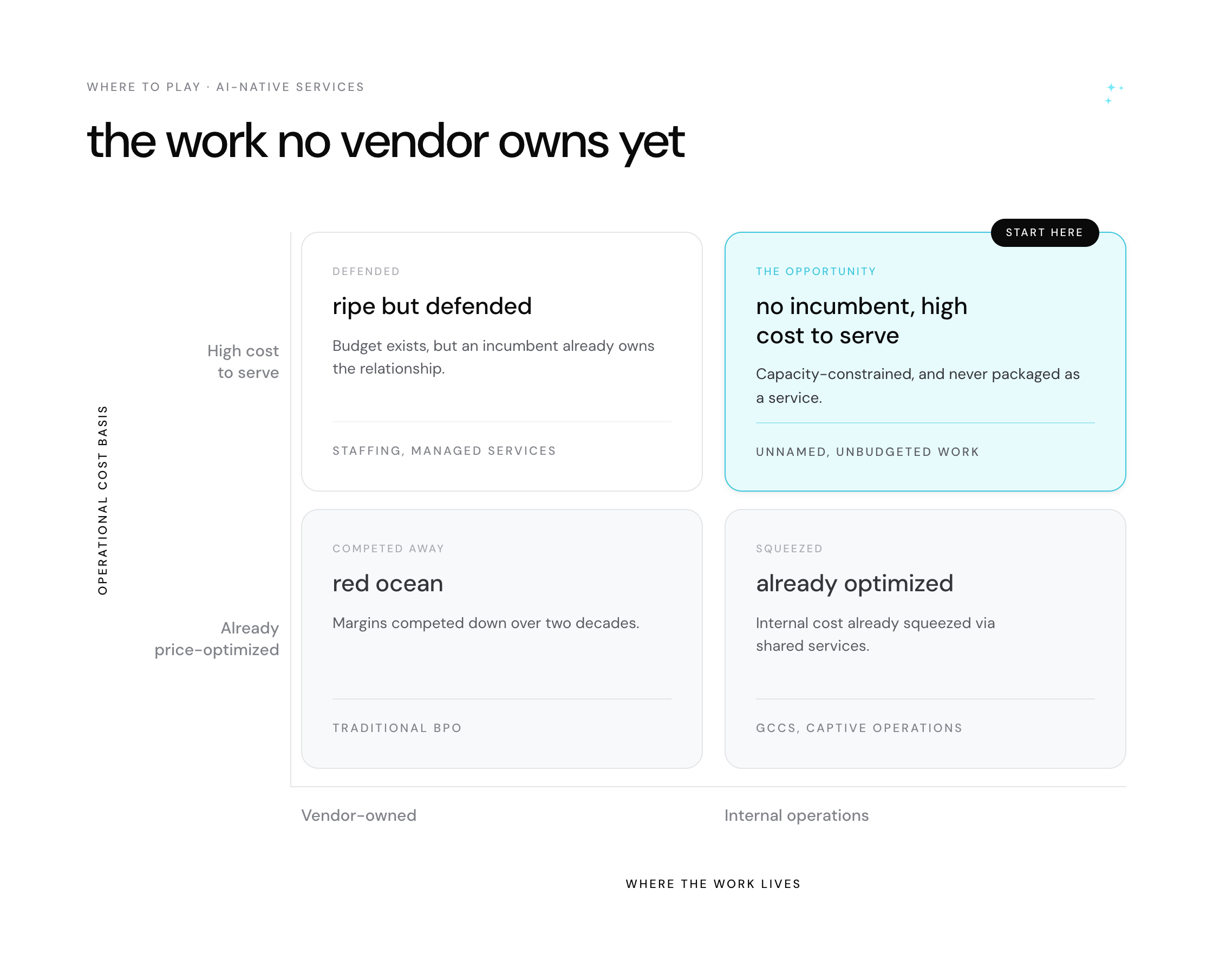
Vendor-owned work — customer support, outsourced finance ops, offshore claims processing — has a named budget and a named incumbent. It is benchmarked, contested, and priced against low-cost labor.
Internal operations work is different. This is where we think many founders should spend more time. Picture a small team inside an insurance brokerage, specialty clinic, lender, logistics company, accounting firm, distributor, or compliance-heavy SMB. The work moves across email, PDFs, spreadsheets, portals, and a core system that was never quite built for the job. That is where the new service categories will emerge.
Then check where the labor sits
One practical way to avoid bad markets is to ask where the labor sits today.
If the work is already offshore at $10,000 to $15,000 per seat, the customer has told you something important. They have already optimized for cost. They have already accepted the tradeoffs of distance, handoffs, and vendor management. You can still win, but you are fighting a tough pricing benchmark from day one.
There are exceptions. If AI unlocks a step change in quality, turnaround time, or accountability, the market can still be attractive. But the burden of proof is high.
The more attractive starting point is expensive domestic operating work that never left.
In the US, that often means mid-skilled labor costing $50,000 to $100,000 fully loaded. The middle layer of administrative and operational work that keeps an industry moving: Submission intake. Claims triage. Document collection. Revenue-cycle follow-up. Renewal prep. Invoice exceptions. Compliance evidence. Quote preparation. Customer onboarding. Policy servicing. Order exception handling.
The labels change by vertical. The shape is consistent.
The work is expensive enough to create a meaningful budget, repetitive enough to learn from, and embedded enough that no incumbent has already taken the margin.
Sell capacity before replacement
The go-to-market has to respect one awkward fact: internal work is emotional.
When a buyer replaces an outside vendor, the decision can be relatively cold. Price, quality, service levels, procurement risk. There may be politics, but the work has already been separated from the team.
When the work lives inside the company, the same pitch lands differently. "We replace your operations team" may sound efficient to a founder, but it sounds threatening to everyone else. It implies the vendor does not understand the nuance of the work, and it alienates the people whose cooperation the company needs during onboarding.
The better wedge is relief. We handle the intake. We chase the missing documents. We prepare the file. We reconcile the exceptions. We draft the first pass. We clear the backlog. The team keeps the decisions, the relationships, and the judgment, while the service absorbs the operational drag around them. We expand capacity - if you were responding to 30% of the requests for quotes, we can now respond to 80%.
The opportunity is not simply to automate work that companies already know how to outsource. It is to make new work outsourceable for the first time.


insights delivered straight to your inbox
