
Why AI Native Services is the Next Big Bet
Why AI native services is the next big bet
AI has pulled venture attention back to the application layer. Every week, the same debates come around in a slightly different form: will agents replace SaaS, will incumbents keep distribution, will workflows be rebuilt around models and what the next big AI company will look like.
But these debates keep the conversation anchored to software budgets, which by itself is a relatively smaller pool of spend. The larger cost pools sit in the work itself: processing claims, reconciling payments, chasing renewals, preparing compliance files, answering customer requests, reviewing documents, moving data between systems, and coordinating across counterparties. Software has improved these workflows for decades, but mostly by giving teams better ways to track, route, and manage work. The outcome traditionally has stayed with people.
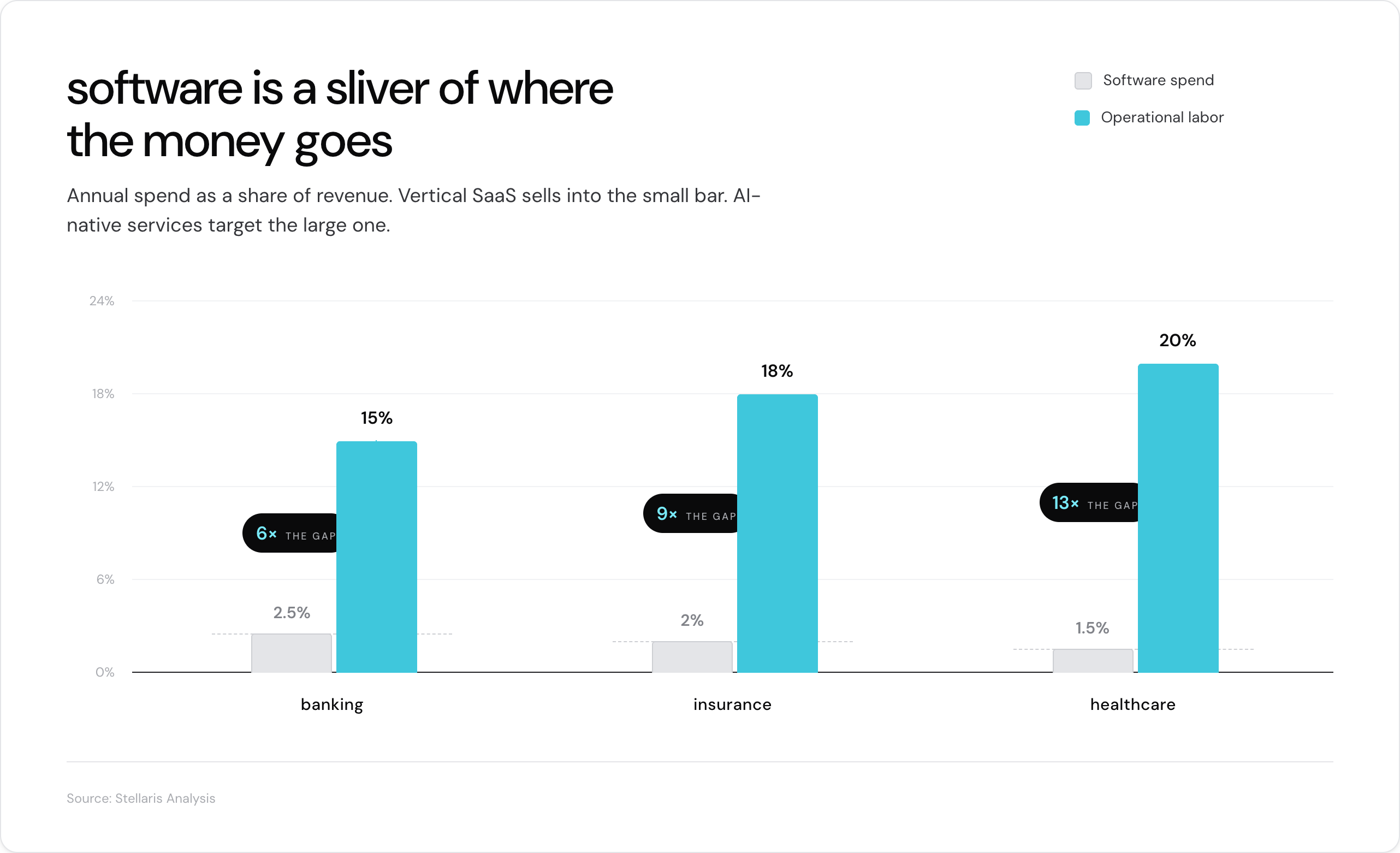
AI changes that picture. A workflow that once required a trained operator to read messy inputs, apply context, and handle exceptions can now be delivered through a system, as long as the workflow is narrow enough, the quality bar is clear, and humans remain close to the parts where judgment and accountability still matter.
That is the opportunity for AI native services: companies that sell completed workflows into operating budgets, with AI changing the cost structure and humans keeping the output production grade.
Why now?
Two shifts are driving this - technology has moved up the stack, and buyer behaviour has changed.
Technology has moved up the stack
Traditional software worked best when the input was structured, the steps were predictable, and the next action could be written as a rule. Once a workflow required interpretation, context, or exception handling, software usually became the place where work was routed and recorded while people continued to do the work.
That boundary shaped enterprise software for decades. Software companies sold systems of record and workflow tools. Services companies supplied labor where software stopped. Buyers stitched the two together internally, often with people sitting between inboxes, spreadsheets, portals, PDFs, and core systems.
LLMs move that boundary upward. They can read unstructured documents, extract meaning from emails, classify requests, draft responses, summarize context, compare records, and reason across incomplete information. They still fail when the environment is too open ended, but many business workflows are narrower than they look. They are mostly repetitive, bounded, and governed by stable rules, even when the inputs arrive in messy forms.
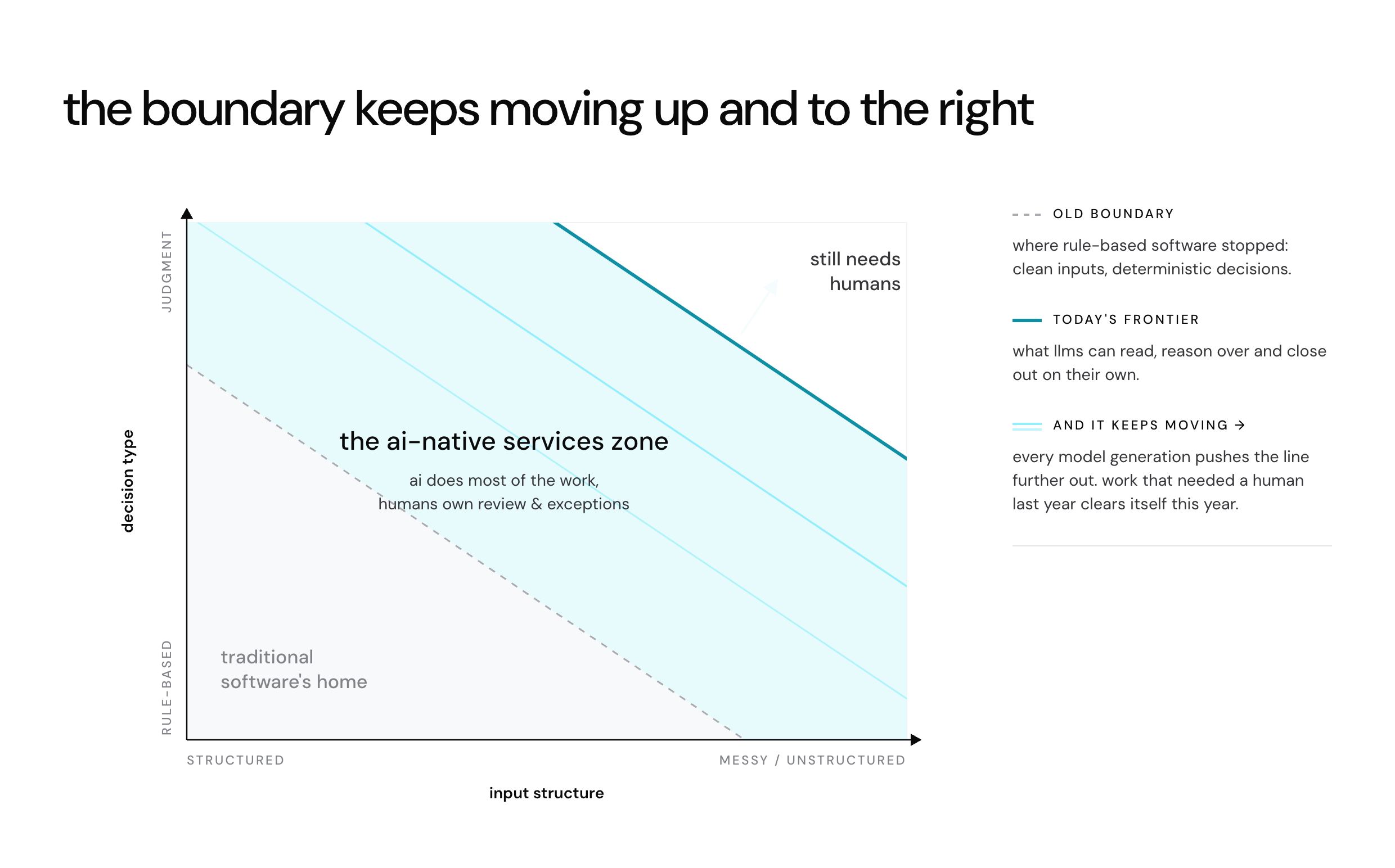
The interesting zone sits in the middle: workflows where AI can do most of the labor, while humans remain responsible for review, exceptions, quality control, and accountability. As models improve, the human layer should get thinner. As the company processes more volume, it should build proprietary workflow data, edge case libraries, evaluation systems, integrations, and domain specific operating knowledge.
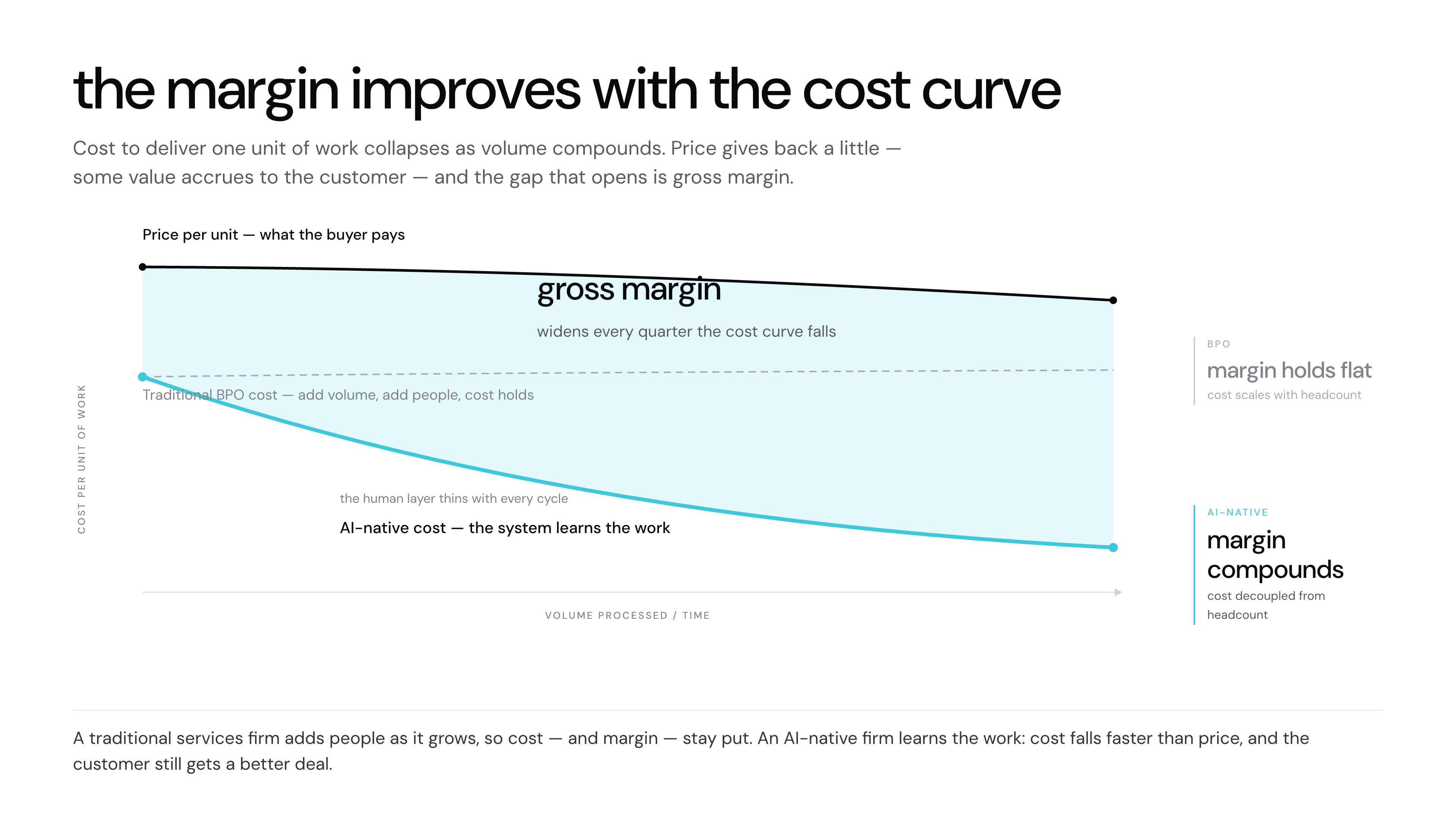
That learning curve is the interesting part. A traditional services company scales by adding people. An AI native services company should improve the ratio between work delivered and human effort required.
Take Kim, which runs customer support for e-commerce teams, and Pibit, which runs insurance underwriting. In both, the system has taken over more of the work as it learned the domain. They have steadily cut the share of work that needs a human from over 70% to ~30%. The work delivered keeps rising while the human effort behind it falls.
The buyer has changed
Over the last decade, companies became much more comfortable with distributed work, offshore teams, remote delivery, and external operating partners. Many business functions already run through a patchwork of internal operators, outsourced vendors, workflow tools, document systems, and manual handoffs. The habit of externalizing work is already there.
At the same time, many vertical software markets are crowded at the application layer. A mid market insurance business, healthcare provider, lender, accounting firm, or logistics company may already have a core system, a CRM, a ticketing tool, a document repository, and several workflow products. The customer's bottleneck is often the burden of coordinating across the software they already use.
They do not need another piece of software. They need someone who can coordinate across this smorgasbord of applications to deliver the work while reducing cost, increasing accuracy, and reducing turnaround times.
The service wrapper matters because the customer does not need to run a software implementation or redesign the operating model upfront. The vendor can start through the channels that already exist: inboxes, portals, PDFs, spreadsheets, CRMs, and core systems.
Where AI native services can win
A natural place to begin could be with existing services categories. Call centers, BPOs, offshore operations teams, IT services firms, and back office vendors are obvious targets because the labor is visible and the processes are already externalized.
Some good companies will be built this way. The challenge is that these markets already have price benchmarks. If the buyer is comparing you to a low cost offshore team, you are competing with a delivery model that has been optimized for decades. The work may look inefficient from the outside, but the margin available to a new entrant can be thinner than it appears.
The more interesting opportunities often show up before a formal vendor category exists.
Spend a day inside an insurance brokerage, specialty clinic, logistics business, accounting firm, lender, or a compliance heavy SMB. A surprising amount of work is repetitive, expensive, and still trapped inside the company because it never cleanly fits into software or outsourcing.
The workflow has structure, but the path is not deterministic. Inputs are often messy, and the process changes by customer, geography, document type, or exception path. The pain is real, but no vendor could historically serve it at attractive economics.
That stranded work is the opportunity for AI native services. It shows up in headcount, cycle time, error rates, backlogs, missed revenue, slow response times, and the quiet drag of teams moving information from one state to another.
BPO 2.0 or a new category?
This category often gets described as BPO with AI.
A traditional BPO takes an existing process and moves labor to a cheaper or more scalable delivery base. Technology helps, but labor remains the main unit of scale.
An AI native services company may look service heavy in the beginning because production quality still requires humans. Early operators understand the workflow, catch failures, manage exceptions, and turn customer specific messiness into repeatable processes. Over time, more of that knowledge moves into software, prompts, review systems, integrations, evaluation datasets, and model feedback loops.
You can see the difference in the numbers. Revenue per operator rises with AI-native services. Exception rates fall. Turnaround time comes down. Gross margins improve with volume. New customers in the same workflow onboard faster because the system has already learned the common paths.
If those curves do not improve, the company is a better services firm. That may still be a good business, but it is not the venture outcome we are underwriting.
A concrete example: MGAs
Consider a $100M revenue managed general agent (MGA) in insurance. An MGA underwrites and services policies on behalf of carriers. It may spend only $1-2M a year on software, which makes it difficult for a traditional vertical SaaS company to serve at venture scale.
But the operating spend tells a different story.
A meaningful share of the cost base goes into submission intake, underwriting preparation, quote generation, renewal follow up, customer communication, policy servicing, and coordination between brokers, carriers, and internal teams.
These workflows have the right shape for AI native services. They involve high document volumes, repeatable decision paths, messy inputs, email-heavy coordination, and enough judgment that pure software historically struggled. They also sit close to revenue, so the buyer cares about speed, accuracy, throughput, and leakage.
An AI native services company can take over submission intake and underwriting preparation as a completed workflow. It can receive submissions, extract the relevant information, check completeness, enrich the file, flag issues, prepare the underwriter's view, and route exceptions to humans when needed.
The buyer can pay per file, per policy, or per completed workflow. They do not need to replace their core system or manage another team. They get faster cycle times and lower operating load.
Pibit is an example of this model in production today, running underwriting workflows for MGAs as an AI native service.
The same pattern appears across healthcare administration, revenue cycle operations, accounting, compliance, logistics, legal operations, and customer support.
India's right to win
India is well positioned for this category because AI native services require both software talent and operating discipline.
The SaaS wave proved that Indian teams could build product companies for global markets. The services wave before it created deep capability in process design, offshore delivery, quality management, training, and customer operations. AI native services sit at the intersection of those two histories.
This matters most in the early stages. The human layer is not a permanent crutch, but it is useful scaffolding. It lets the company deliver quality while the system learns, and it creates the feedback loop through which workflow knowledge becomes software leverage.
Teams that can combine model engineering with disciplined operations will have an advantage over teams that treat service delivery as an implementation detail.
Many of the best initial customers will be small and mid market companies in the US and other developed markets: businesses with operating pain, meaningful budgets, and limited appetite for complex software transformation. Indian founders can serve these customers with a cost efficient delivery model from day one, then use AI to expand margins over time.
Labor arbitrage is part of the story in some markets, but it is not the main event.
What founders need to get right
AI native services companies need to be designed across a different set of axes than SaaS companies.
Which workflows are frequent, painful, bounded, and valuable enough to absorb? Should you build horizontally across industries or go deep into a vertical? How should you price around transactions, files, workflows, or outcomes? Where should you place the boundary between AI, human review, and exception handling? How should gross margins improve as volume grows? Should you build the operating layer from scratch or acquire an existing services business and rebuild it around AI?
These design choices, and the operating principles behind them, will be the focus of the next few articles in this series.
The bet
AI native services expand the venture opportunity from software budgets into operating budgets. That is why the category matters.
The first wave of AI applications has focused on making knowledge workers faster. The larger wave will focus on taking work off the customer's plate entirely.
In industries where work is repetitive, document heavy, coordination heavy, and expensive to manage, buyers often do not want another tool. They want the workflow to move with less effort, less delay, and fewer errors.
The best founders in this category will understand the operating reality of the work today and the rate at which AI can absorb more of it tomorrow. They will choose workflows carefully, price against outcomes, build delivery organizations with software like learning curves, and use human operations as a way to create system intelligence.
That is the bet behind AI native services: a new way to deliver the work itself.


insights delivered straight to your inbox
