
Slope is everything in AI native services businesses
The venture case for an AI-native services company is not reliant on whether AI can automate the workflow today. On day one it usually can’t, and the demos that suggest otherwise are the ones to distrust.
The hypothesis is that automation rises - and rises quickly and defensibly enough that a business that looks like a service in year one becomes much more “software like” in a few years, and far more valuable in the process.
The thing to underwrite, then, is whether the offering becomes less service-like over time. Does the same unit of work get cheaper to deliver? Do mature customers need less human review? Does the next customer onboard faster than the last? Do corrections become product improvements, or just tribal memory inside the ops team? The rate at which the human cost of delivering the same unit of work falls over time is the ‘slope’.
And in AI native services, the slope is everything.
A flat slope can still produce a useful business, even a profitable one. But it is a services business with AI bolted on. A steep slope on the other hand builds a company that delivers with humans to earn trust initially, then turns that delivery into software leverage.
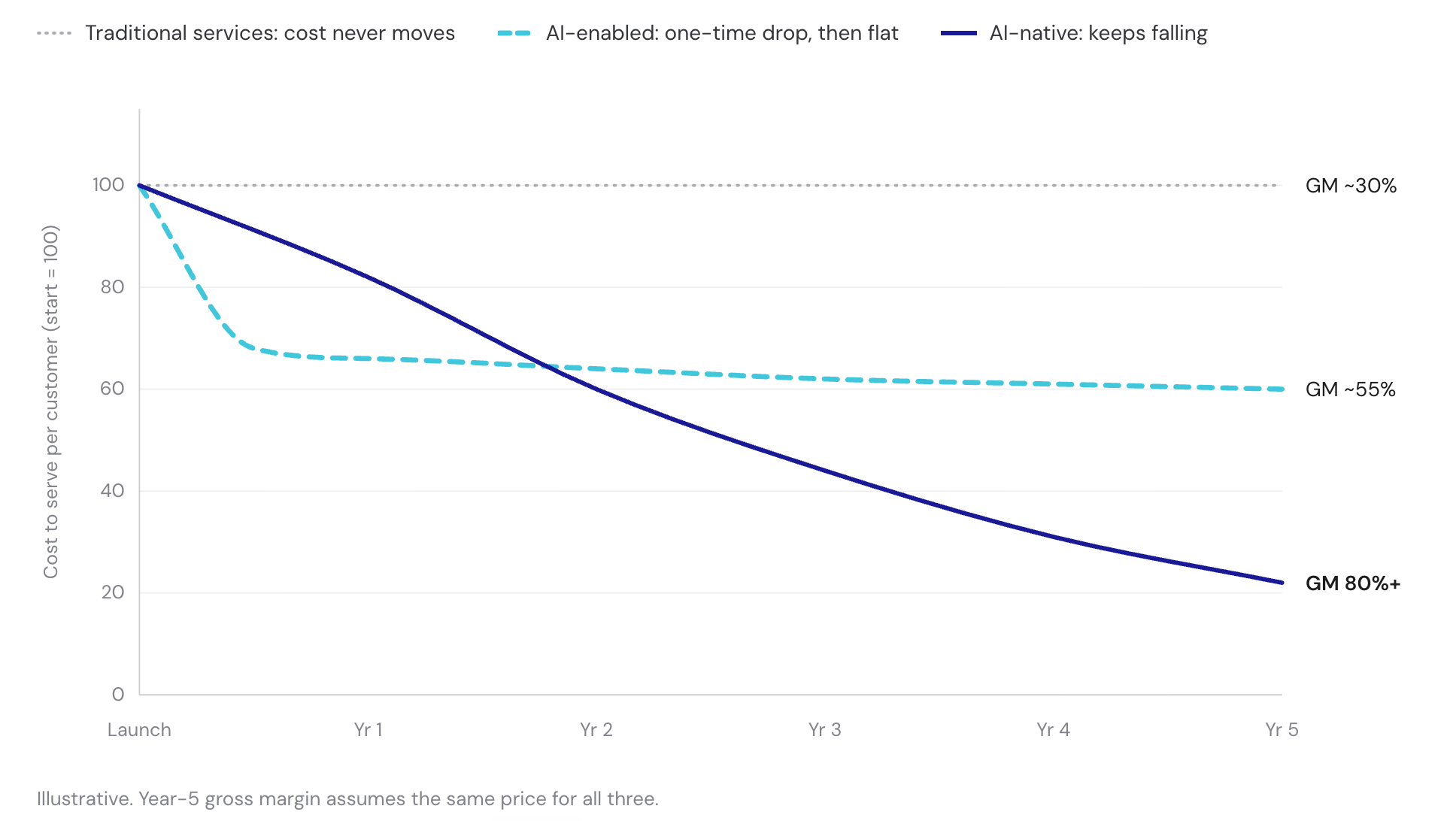
An “AI enabled” services company uses AI to reduce the cost of today’s work. An AI native services company uses today’s work to reduce the cost of tomorrow’s.
Workflow determines the slope
Every workflow is a bundle of smaller tasks. Some are mechanical: extract the field, classify the document, route the case, draft the response. Others require judgment: decide whether the exception matters, weigh conflicting information, handle the angry customer, know when an incomplete file is actually dangerous.
The first move should be to break the bundle apart.
If a strong operator can explain the decision path for most cases, AI can probably take on a meaningful share of the work. If the operator says “you just develop a feel for it” and can’t turn that feel into examples, rules, review criteria or escalation logic, the workflow will likely stay human.
An 80/20 workflow can be attractive: mostly structured work with a thin layer of judgment on top. A 50/50 workflow can still work if the judgment layer can narrow over time. But a 20/80 workflow, where judgment dominates, remains a professional services business with AI in the stack.
But even the ratio can fool you.
A workflow that is only 60 percent automatable today can be great if there is a believable path to 90. One that looks 80 percent automated can be a nightmare if the last 20 percent is expensive, chaotic and impossible to supervise cheaply.
The residual work matters more than the automated work.
The slope is the path through the residue. It is not what AI can do today, but what it can learn to do from the exceptions, chipping away at the human component over time.
Drivers of slope
You don’t have to wait two years to know whether the slope is real. Mature cohort data helps, but the conditions that create a steep slope show up much sooner. There are two things to look for.
1. Customers are similars and errors are repetitive
If errors cluster into a handful of repeatable types, that is promising. Each fix can retire a real chunk of future errors. The company learns once and benefits many times.
If the errors are a long tail of strange one-offs, the slope is not as steep. Every fix helps one case and does almost nothing for the next hundred.
Two companies can both say they automate 70 percent of the workflow. One might have five recurring error types and the other 200 little exceptions. They will compound very differently. Most workflows, in our experience, follow a pareto, and lie in the former category rather than the latter. In our own portfolio, we are experiencing this in customer support with Kim.cc, in bookkeeping with Atlas.ai, and in P&C underwriting with Pibit.ai.
Errors are more repeatable if customers are similar - similar documents, systems, exceptions, rules and quality bars. If customers rhyme, learning transfers, and a lesson from one customer makes the next one cheaper to serve. If every customer is its own little universe, the company keeps starting over.
2. Judgment is compressible
Some cases will always need a human. The question is whether that category shrinks when you break it down.
If the decision of whether a case needs human review can be split into a decision tree of smaller if/else scenarios, each narrow enough for an LLM to handle with high fidelity given examples, rules and evals - that makes the system a lot more robust.
A refund decision, for example, can be broken into deterministic checks on eligibility under the company’s terms, amount, reason and so on. A human is needed only for outlier complaints.
Judgment has not disappeared, but it has been boxed in.
The feedback loop is the engine
The slope doesn’t appear simply because the model got better in the background. It appears because the company has built a system that turns human work into learning.
Human work creates corrections. Corrections create structured feedback. Feedback improves the system. The improved system requires less human work.
A real feedback loop is an engineered system. Every human correction is captured with its full context: the input, the model’s output, the corrected output and the reason for the correction. Those corrections feed an evaluation set. Every change is tested against that set before it ships, whether it’s a new prompt, model version, extraction logic, routing rule or review step. Regression tests catch the improvement that quietly breaks three other cases. Errors are classified by type and severity. Quality is tracked as a distribution - because quality in this category is inherently probabilistic.
The loop also has to connect operations and engineering, because the knowledge is split across them. Operators see the failures. Engineers build the system. Domain experts understand the judgment behind the corrections.
When issues are raised and resolved over informal channels, context gets lost in the noise. To turn human learnings into code, an input layer has to convert one team’s feedback into the other team’s ideas. This structured loop is what turns the human layer from a cost that scales with revenue into an asset that shrinks the cost of the next unit of work.
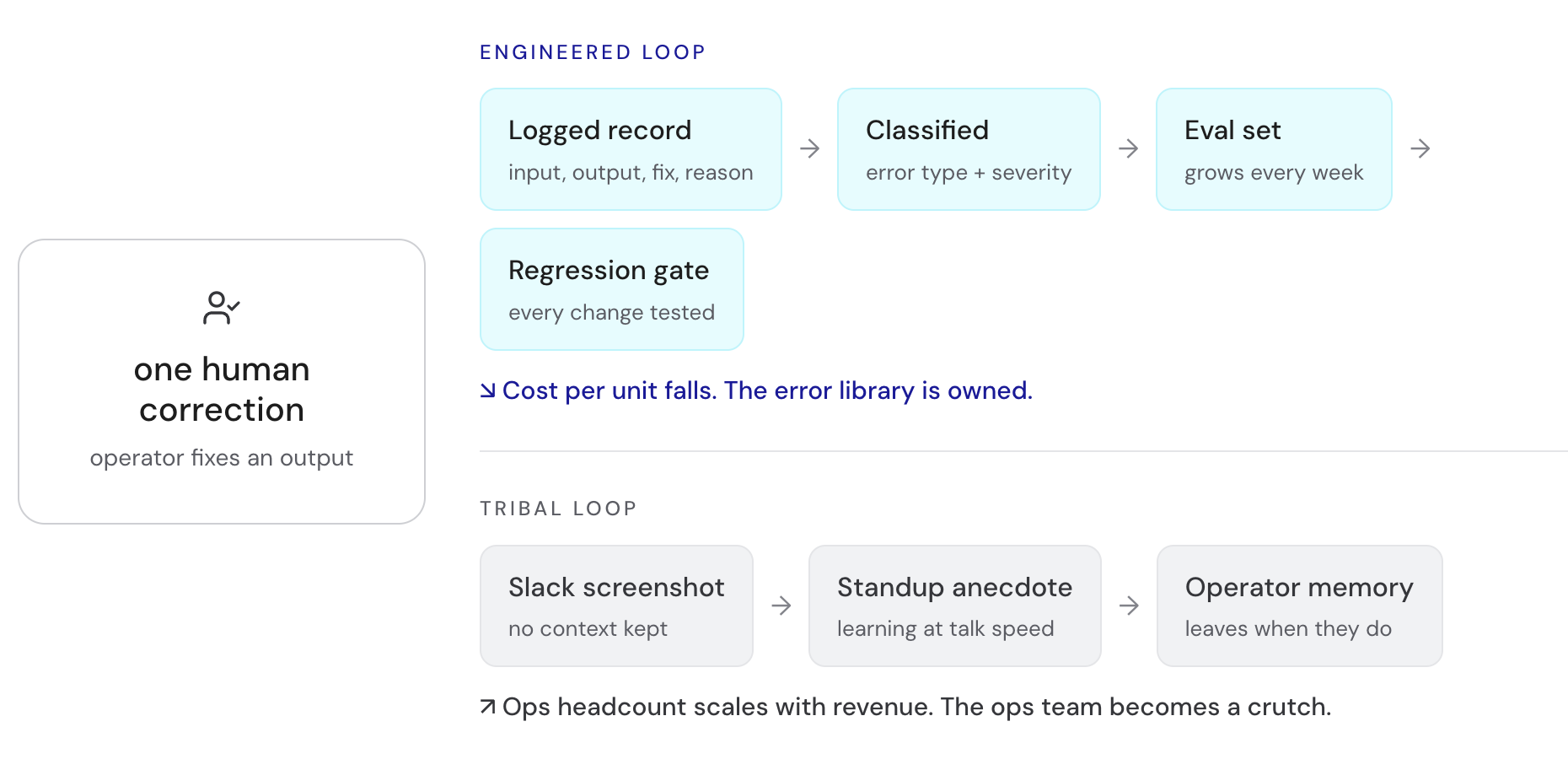
But the loop also has to compound faster than competitors can replicate it. Otherwise the company may become more efficient without becoming more defensible. The question is not just whether the system learns, but whether it learns from proprietary work, at a rate the next entrant will struggle to match. Model improvements are available to every competitor, including incumbents with delivery teams a hundred times larger. Proprietary corrections are not. The model may be rented, but the error library is owned.
Gross margin is the scorecard
Revenue can be misleading for a long time in this category.
A company can grow by throwing people at the problem: hire more operators, add more QA, keep humans in every loop. Customers may still be happy, because the work gets done.
The ARR chart will look fine. Gross margin is harder to fake.
Early gross margin will look ordinary. In the beginning, the company is learning the work, mapping edge cases and building trust. It uses humans generously because the buyer can’t be asked to absorb risk. A 40–50 percent gross margin early on can be perfectly reasonable.
But it can’t stay there. To underwrite a venture-scale slope, we want to see a credible path to 80 percent-plus gross margin on mature cohorts. Over time, the best cohorts should look much more like software than services.
These are not public benchmarks; the category is too young and too private for that. They are the bet. If we are underwriting a venture outcome, this is the margin movement we are implicitly factoring in.
Blended gross margin, however, can punish a good company for growing quickly. New customers are expensive. Their edge cases are unknown. Their workflows need heavier review. A company adding many new logos can show a worse blended number even as its older cohorts improve.
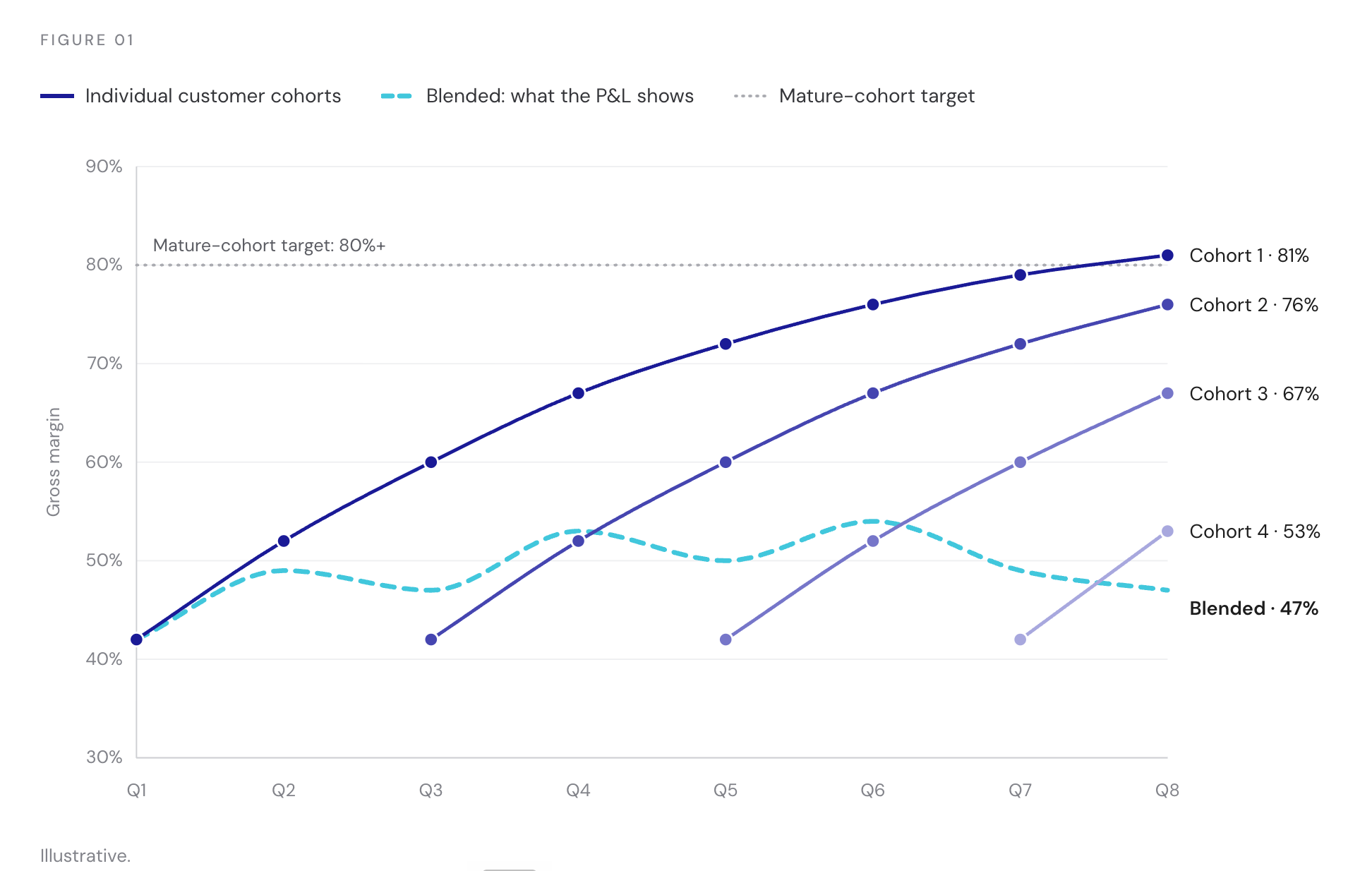
Mature cohorts are the cleaner test. Are customers from six, twelve, and eighteen months ago cheaper to serve now than they were before? Are operators reviewing fewer routine cases? Is the same customer producing more gross profit without the team doing heroics in the background?
It is important to focus not only on the shape of a cohort, but also whether or not the shape of successive cohorts is changing or not. Customers from a year ago may have taken 12 months to go from 40 to 70 percent gross margin; later cohorts should compress that timeline. We think of this as the second derivative of the slope. It is what lifts the gross margin profile even through very rapid customer growth. You are not just learning from errors. You are learning faster.
Slope, however, is not the only driver of margins. One of the challenges of AI native services is pricing. As a provider, one may be creating value (i.e. have a steep slope), but there is a risk that most of this value is captured by the customer. Slope only becomes margin when pricing is tied to the unit of work or the outcome. Pricing is how a company keeps what it learns. A company that prices per FTE hands its slope to the buyer at every renewal: the work gets cheaper, and so does the contract.
Follow the slope
Once the core workflow is working, the next question is where to expand. There are three directions:
- Expansion within the vertical: the same workflow across more customers in the same vertical.
- Expansion of workflows: more workflows inside the same customers.
- Expansion of verticals: the same workflow across new verticals.
Early on, the slope is usually strongest within a vertical. The next customer in the same vertical brings similar documents, systems, exceptions, regulations, buyer expectations, and quality bars. That low intra-vertical variance allows learning to transfer. The feedback loop deepens instead of resetting.
Once there is credibility with a customer, and the team understands the business context deeply, expansion into adjacent workflows is easier. It also has the advantage that acquisition of this additional revenue comes with much lower CAC.
One of our portfolio companies, Pibit, is a great example of this expansion. They are building an AI native services company in insurance underwriting. They started out with a relatively smaller chunk of work - loss run analysis - but have since expanded to cover ingestion, enrichment, normalisation and offer a comprehensive workbench to the underwriter. They have seen their accuracy across workflows go up from 70% to ~90% over the last year, owing to the feedback loop from staying focused on a few workflows within a vertical.
Expansion of verticals can look attractive because the adjacent market is large. But a new vertical can bring a completely different set of documents, rules, exceptions, and quality bars. The company may be starting over. That said, there could be situations where adjacent verticals are relatively similar. A company serving the steel industry, for example, may find other metals like aluminum or copper fairly adjacent, and perhaps process industries like chemicals and oil & gas.
The discipline is to pick the axis where the slope improves. Expand where learning compounds. Refuse the expansion that resets the climb, no matter how large the adjacent market looks on a map. They should not be chosen simply to make the TAM slide bigger.
The bet we are making with AI native services
AI native services promise something simple and hard: Do the work like a service today. Become less like a service every quarter.
That happens when a company picks a workflow that decomposes, chooses customers that resemble one another, captures feedback properly, compresses judgment, and expands in the direction of learning, improving gross margin over time.
When that works, the service becomes software.
The delta is not how much AI the company uses today. It is how quickly the human layer disappears.
That is the slope.



insights delivered straight to your inbox
